

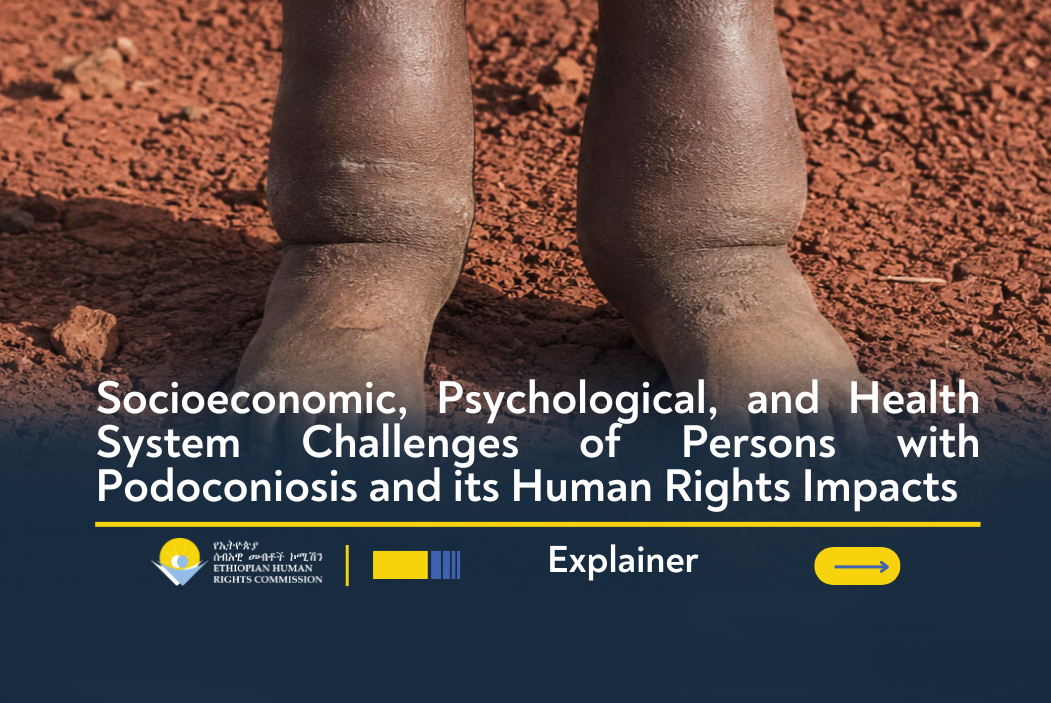
What is Podoconiosis?
Podoconiosis is a chronic, progressively disabling and disfiguring neglected tropical disease (NTD).[1] The disease typically presents as bilateral but asymmetrical swelling of the lower legs, resulting from long-term barefoot exposure to red-clay soils derived from volcanic rock.[2] Although the exact causes of podoconiosis are not fully understood, current evidence indicates that the condition arises from long-term contact with volcanic red clay soils.
Globally, an estimated 4 million people are affected, primarily in tropical regions of Africa, Central and South America, and Southeast Asia. Podoconiosis is particularly prevalent in Ethiopia, where more than 345 woredas are endemic for the disease.[3] Studies estimate that up to 1.5 million people in Ethiopia live with podoconiosis, and between 34.9 and 43.8 per cent of the population resides in environments conducive to its development.
What are the human rights impacts of Podoconiosis?
People affected by podoconiosis commonly experience physical limitations due to swelling, pain, and discomfort in the lower limbs which restrict their ability to stand or walk for extended periods. This functional impairment reduces work capacity, increases absenteeism, and lowers productivity, often resulting in financial hardship, loss of livelihood, and increased dependence on family members for physical and economic support. The disease imposes a heavy social, psychological, and financial burden and threatens educational and employment opportunities.
Although podoconiosis is a preventable, non-communicable disease, it remains poorly understood, and misconceptions about its causes, prevention, and treatment are widespread. Consequently, affected individuals frequently face profound social stigma from community members and, at times, from health professionals.[4] These social consequences constitute serious human rights violations manifesting in systemic social isolation and unequal treatment across various settings. Particularly, affected persons are systematically excluded from social gatherings such as weddings and funerals, experience discrimination in marriage prospects, and are denied leadership and decision-making roles in their communities. The exclusion also extends to socio-economic rights, with compounding effects on livelihoods and future opportunities. For instance, when children affected by podoconiosis are excluded from attending schools due to peer and institutional prejudice, their right to education is violated, thereby affecting their future employability and standard of living. Similarly, social isolation can deter individuals from engaging in business activities, forcing them into economic isolation and ultimately leading to systemic poverty in violation of their rights to livelihood and work.
In summary, people living with podoconiosis encounter one or more forms of stigmatization in everyday settings, including schools, religious institutions, and marketplaces.
Common expressions of stigma include:
- Reluctance to marry affected individuals or their family members, and divorce if the spouse develops the condition;
- Deliberate avoidance and refusal of physical contact;
- Exclusion of patients and family members from social gatherings;
- Use of derogatory gestures, such as covering the nose when passing an affected person;
- Refusal by classmates to share seating at school;
- Unwillingness of unaffected family members to approach an affected relative; and
- Unwillingness of customers to purchase goods sold by affected individuals.
As a result of pervasive stigma and social exclusion, individuals with podoconiosis often withdraw from community life into isolation. Furthermore, these stigmatizing attitudes contribute significantly to mental health challenges, including low self-esteem, psychological distress, and difficulties with self-acceptance. Such experiences not only compound the social burden of the disease but also hinder timely health-seeking behaviour and adherence to treatment, thereby worsening overall health and quality of life.
What is the situation in Ethiopia?
The Government of Ethiopia, in collaboration with non-governmental organizations (NGOs), has taken important steps to address podoconiosis within the broader neglected tropical disease (NTD) agenda.[5] Through the third National NTD Strategic Plan (2021–2025), podoconiosis has been prioritized for elimination and control in endemic districts, with interventions focusing on lymphedema morbidity management, psychosocial support, stigma reduction, and behaviour change communication. These efforts align with the Health Sector Transformation Plan and the WHO NTD Road Map (2021–2030).
NGOs have played a critical role in piloting and delivering community-based care, including foot hygiene, wound care, footwear provision, and health education, particularly in remote rural areas. Some organizations have also introduced psychosocial support initiatives and community awareness programs to address stigma and fatalistic beliefs about the disease. However, these services remain uneven, often limited in scale, and heavily dependent on external funding, with ongoing challenges related to supply availability, trained personnel, and access to care at the primary health level.
To further reduce the burden of podoconiosis, the Ethiopian government should prioritize strengthening and scaling up existing, feasible interventions rather than introducing entirely new systems. To meet its human rights obligations, the government must systematically integrate podoconiosis care into the national healthcare framework guided by the Availability, Accessibility, Acceptability, and Quality framework. This requires ensuring the availability of essential supplies, like soap, ointment, and custom footwear, through the Pharmaceutical Fund and Supply Agency, while making treatment accessible by embedding routine management into primary health care clinics to remove geographic and financial barriers for rural families. Furthermore, the government must guarantee acceptability and quality by mobilizing health extension workers to counter harmful community myths, alongside expanding professional medical training to eradicate institutional stigma within healthcare facilities.
Realistic, community-based health education programs should be intensified to address misconceptions, reduce stigma, and promote early care-seeking, particularly through health extension workers. Introducing a subsidized cost-recovery mechanism can improve sustainability while maintaining affordability for poor households.
Additionally, stronger multisectoral collaboration with water, sanitation, housing, and education sectors can support preventive measures such as improved flooring, footwear use, and foot hygiene. By reinforcing local health infrastructure and maintaining partnerships with NGOs, Ethiopia can make measurable progress towards reducing new cases and improving quality of life for those already affected.
[1] Kidus Meskele, Realizing the right to health of people living with Podoconiosis; Lessons from the field, PP 2
[2] Tekola Ayele F, Alemu G, Davey G, Ahrens C. Community-based survey of podoconiosis in Bedele Zuria woreda, west Ethiopia, PP 119.
[3] Muluken M, Yohannes K, et al, ‘Lived Experience of People living with podoconiosis in Southern Ethiopia: a phenomenological study’, 2025, PP 3
[4] Temesegn L, Amene, et al, ‘Stigma Related to Podoconiosis in Ethiopia; A Systematic Review’, PP 4
[5] Kebede D, Biruck K, ‘PODOCONIOSIS In Ethiopia: From Neglect to Priority Public health problem’, 2017, PP 65