

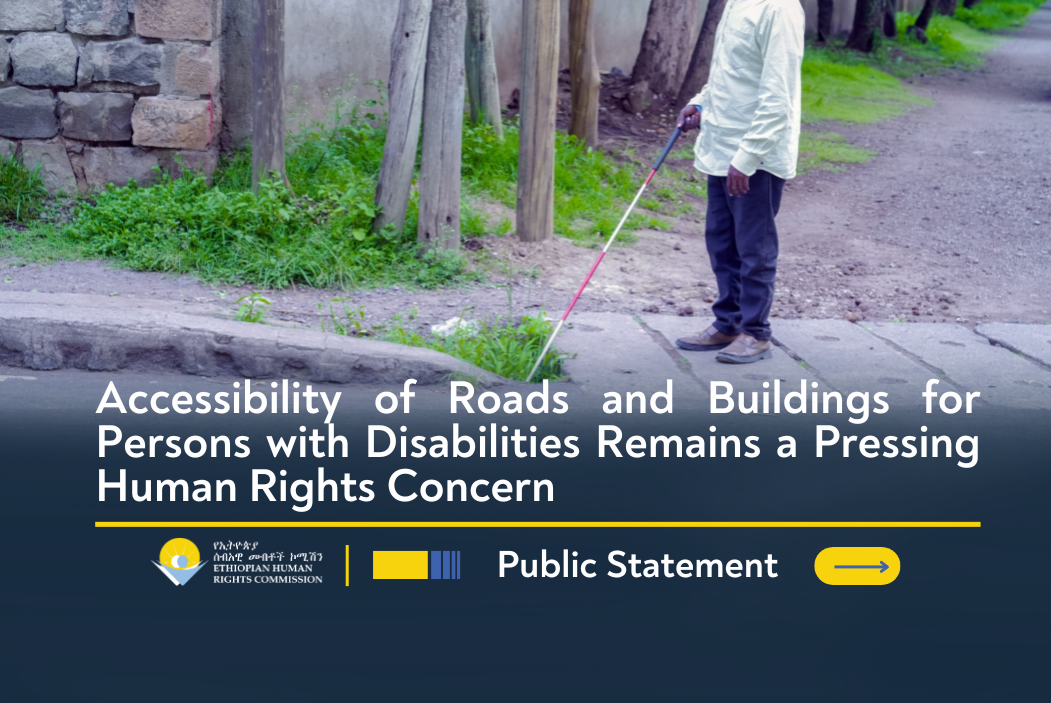
The Ethiopian Human Rights Commission (EHRC) conducted a public hearing in Hawassa City on April 28 and 29, 2026, as part of its ongoing systemic human rights investigation into the accessibility of roads and buildings for persons with disabilities. The hearing focused on barriers affecting accessibility of roads, buildings, and public services for persons with disabilities. This follows an earlier public hearing held in Addis Ababa on December 26 and 27, 2024, which focused on accessibility of buildings as an initial component of the broader systemic investigation.
During the hearing, EHRC heard over 70 different complaints from 24 victims of alleged human rights violations, including 16 men and 8 women. Among the victims, 7 were blind, 15 had physical disabilities, and 2 were deaf. Nineteen victims presented their cases in person, one was heard confidentially, and four were represented by others.
The public hearing revealed that accessibility of roads and buildings remains a pressing human rights concern for persons with disabilities in Ethiopia. Lack of accessibility significantly limits the ability of persons with disabilities to exercise fundamental rights, including the rights to health, education, work, equality in accessing public services, freedom of movement, and the right to participate in cultural life. It also exposes persons with disabilities to significant threats affecting their physical, psychological, economic and social well-being.
EHRC’s systemic investigation was initiated in response to the structural, recurring and prevalent nature of these challenges across different parts of the country. Systemic human rights investigations help examine consistent patterns and trends of violations, rather than isolated incidents, as well as the underlying structural causes that enable recurring violations, with the aim of identifying widespread issues and recommending long-term reforms. Public hearings form part of this process by enabling victims to present their cases directly before responsible institutions and relevant governmental and non-governmental stakeholders.
Victims who testified during the hearing described inaccessible roads and buildings as major barriers to their daily lives, preventing them from fully exercising their human rights. They highlighted challenges in accessing health services, education, employment, and public services, as well as serious safety risks caused by inaccessible infrastructure. Particular concerns were raised regarding open manholes and drainage holes left unattended without proper signage following infrastructural works undertaken by Ethio Telecom, the Ethiopian Electric Utility, and other entities.
Victims further reported that inaccessible toilets and entrances in health facilities make it extremely difficult for persons with disabilities to seek medical care, forcing them to struggle even during sickness. Women with disabilities specifically testified to the difficulties faced during pregnancy and childbirth, describing degrading situations in health care facilities where no accessible procedures or accommodations were provided.
In addition, the inaccessibility of educational institutions was cited as a major barrier, denying persons with disabilities the opportunity to empower themselves through education and fully participate in social and economic life. Inaccessible workplaces similarly continue to exclude many persons with disabilities from formal employment, often forcing them into informal employment, unemployment, or dependency. Victims also described how inaccessible public institutions compel persons with disabilities to rely on the support of others to access essential services such as banking.
A total of 23 institutions against whom complaints were lodged as well as relevant government stakeholders participated in the public hearing as respondents. Following the testimonies, respondents acknowledged many of the concerns raised against their respective institutions and committed to making the necessary adjustments to ensure accessibility of roads and buildings for persons with disabilities. Institutions further pledged to collaborate with relevant organizations of persons with disabilities and to strengthen implementation of accessibility standards. Authorities responsible for construction permits, regulation, and supervision further committed to strengthening enforcement and oversight mechanisms.
Roads and buildings must be designed, constructed, and supervised in strict compliance with national and international legal standards before they begin public service. Health facilities, banks, schools, and other public and private institutions are required to ensure full accessibility and provide inclusive services for persons with disabilities, while meaningfully incorporating their input in accessibility-related decisions.
EHRC strongly emphasizes the need for all respondent institutions to fully comply with the recommendations issued. It also calls on building construction permit and supervision authorities to effectively monitor and ensure the implementation of these recommendations by the institutions concerned.
EHRC’s Civil, Political and Socio-Economic Rights Commissioner, Dr. Abdi Jibril, stated that millions of persons with disabilities in Ethiopia continue to face the harsh reality of inaccessible buildings and roads, which are essential for their daily life. As a result, they are unable to fully enjoy their rights to health, education, work, equal access to public services, autonomy, and dignity on a daily basis. He emphasized that infrastructure is built at great cost and must be accessible to all without discrimination. Dr. Abdi further emphasized the importance of recognizing institutions that construct accessible buildings and thanked victims for bringing their lived experiences to light, as well as the respondent institutions for their commitments to take corrective action and bring about meaningful change.