

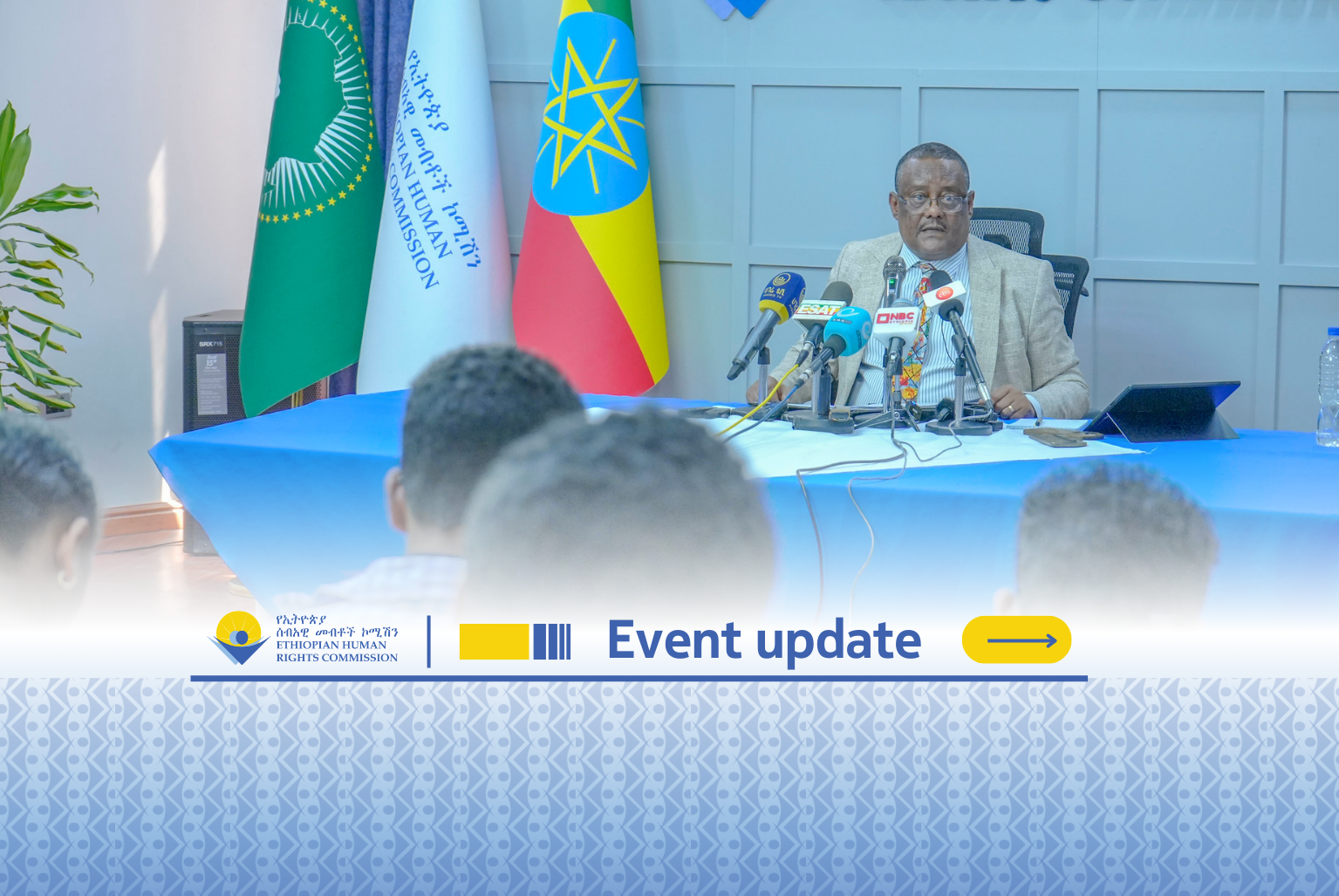
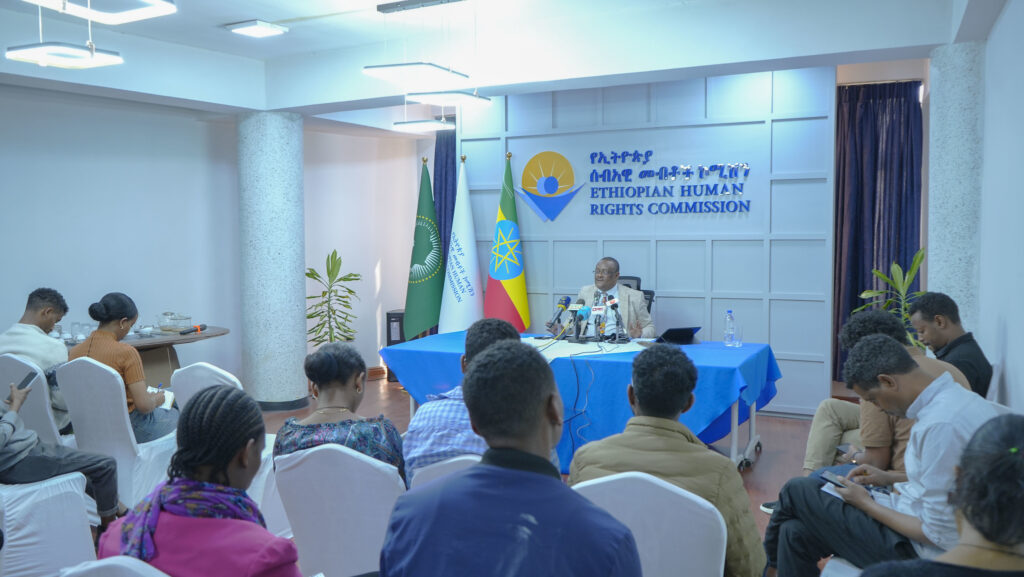
The Ethiopian Human Rights Commission (EHRC) convened a press conference at its head office on February 24, 2026, to present key achievements, progresses, and challenges encountered during the past six months of its operation. The event was attended by members of the media.
The press conference aimed to formally announce Ethiopia’s selection to host NANHRI’s 2027 General Assembly and 16th Biennial Conference, the election of EHRC Chief Commissioner Berhanu Adelo as the Vice Chairperson of the Network, and underscore the institutional, national, and regional significance of the development. In addition, the briefing aimed to highlight key achievements and challenges identified through EHRC’s human rights monitoring, investigation, and advocacy activities conducted during the first half of the 2025/26 fiscal year.
EHRC’s Selection to Host NANHRI’s 2027 General Assembly and 16th Biennial Conference and the Election of EHRC Chief Commissioner Berhanu Adelo as Vice Chairperson of the Network
In a statement delivered at the press conference, EHRC Chief Commissioner Berhanu Adelo announced that EHRC was unanimously selected to host the forthcoming General Assembly and 16th Biennial Conference of NANHRI. The decision was adopted during the Network’s General Assembly held on February 4, 2026, in Yaoundé, Cameroon, where EHRC Chief Commissioner was also unanimously elected Vice Chairperson of the Network for a two-year term.

Established in 2007 and its Secretariat based in Nairobi, Kenya, NANHRI is a regional umbrella body that comprises 47 National Human Rights Institutions (NHRIs) across Africa and is mandated to support the establishment and strengthening of independent NHRIs, promote institutional cooperation, and enhance their capacity to protect and promote human rights in accordance with their respective mandates. Pursuant to Articles 28 and 56 of its Constitution, the Network convenes a General Assembly in ordinary sessions every two years and a Biennial Conference addressing human rights issues, as determined by its Steering Committee in consultation with the Network’s members and partners.
The press conference highlighted factors that contributed to EHRC’s selection as host of the forthcoming General Assembly and Biennial Conference. These included the nation’s demonstrated commitment and government’s support for hosting the event, EHRC’s proactive engagement in strengthening partnerships with international, regional, and partner organizations, and the Commission’s broader contributions to the protection and promotion of human rights within Ethiopia.
The Chief Commissioner underscored that hosting the General Assembly and Biennial Conference in Ethiopia serves as a formal recognition of EHRC’s ongoing contributions to the protection and promotion of human rights. It was noted that event will help strengthen Ethiopia’s regional and international engagement, while providing EHRC with a strategic platform to exchange best practices with peer institutions to reinforce its operations. Furthermore, he explained that the forum will play a pivotal role in creating synergies by enabling government agencies, civil society organizations, academic and research institutions, and policymakers to engage, deliberate, and network with various regional and global human rights leaders, researchers, and representatives of NHRIs.
In addition, Chief Commissioner Berhanu highlighted that EHRC has been elected as the Vice Chair of NANHRI’s Business and Human Rights Working Group. He expressed profound gratitude to the Government for its support in securing Ethiopia’s successful bid to host the General Assembly and the 16th Biennial Conference. He further called upon relevant governmental and non-governmental stakeholders to provide their proactive cooperation and assistance to ensure the successful organization of these events. The Commissioner also confirmed that a dedicated Secretariat has been established within EHRC, and that preparatory activities are already underway.
EHRC’s Human Rights Works, Key Progresses and Challenges Over the Past 6 Months
The Chief Commissioner emphasized that over the past year, EHRC conducted high-level visits to all regional states, except for the Harari Region and Dire Dawa City Administration. During these visits, EHRC held strategic dialogues with Regional Presidents, Speakers of Regional Councils, and Presidents of Regional Supreme Courts. These engagements have produced positive outcomes, with several regional administrations taking concrete steps toward implementing EHRC recommendations.
Accordingly, over the past six months, a total of 1,336 unlawfully detained individuals were released following EHRC’s advocacy. This includes 186 from Amhara, 46 from Benishangul-Gumuz, 66 from Gambella, 915 from Oromia, and 123 from Somali regions. Additionally, 122 individuals were released on bail, while 119 others were granted court hearings. During this period, EHRC received 761 complaints, of which 477 were resolved, while 70 complaints submitted via the mobile complaint handling (MCH) system were successfully addressed. EHRC also conducted monitoring visits to 321 police stations, 42 prisons, and 9 informal detention centers. Notably, the revision of daily subsistence budgets for prisoners and detainees across the majority of prisons stands out among the encouraging outcomes.
Regarding civil and political rights, it was noted that the National Election Board of Ethiopia (NEBE) has achieved significant milestones in its preparations for the 7th National General Election. These include the utilization of the Geographical Information System (GIS) for the strategic identification and mapping of polling stations, the expansion of its regional reach by increasing branch offices to 22, and the development of a digital registration system that enables remote registration for both voters and candidates. The Chief Commissioner clarified that EHRC’s election monitoring mandate involves monitoring the pre-election and election-day processes to ensure compliance with human rights standards, documenting findings, and publishing official reports. In this regard, it was noted that EHRC has finalized its preparations to monitor the upcoming national election.

Significant advancements related to social and economic rights over the past year include the submission of the draft National Policy on Persons with Disabilities to the Council of Ministers, as well as the submission of the Protocol on the Rights of Persons with Disabilities in Africa to the Ministry of Foreign Affairs and the Office of the Prime Minister to ensure signature by the executive. Furthermore, the Digital Ethiopia 2030 Strategy has integrated “Inclusive by Design” as a core strategic principle to ensure the inclusion of persons with disabilities and older persons. In the legislative domain, the General Education Proclamation No. 1368/2024 formally recognized the right to education, while the Health Service Administration and Control Proclamation No. 1362/2024 and the Ethiopian Pharmaceutical Supply Service and Medicine Fund Establishment Proclamation No. 1354/2024 (2017 E.C.) included provisions that help establish an equitable and accessible healthcare delivery system.
Despite a declining trend, significant challenges persist including the continued loss of life, bodily injury, and property damage resulting from armed conflict; abductions by armed groups along transit routes; the prevalence of arbitrary arrests including in cases not subject to criminal liability or without court orders; and the persistent failure to initiate criminal investigations into complaints filed against government officials.
Conditions in detention facilities also remain inadequate. Food, healthcare, and other essential services for prisoners are insufficient, largely due to limited or non-existent government budget allocations for suspects in custody. The briefing also highlighted ongoing pressures exerted on journalists, bloggers, and social media activists. Additionally, human rights violations within the mining sector, particularly in the Gambella and Southwest Ethiopia Regions, were cited as significant areas of concern regarding human rights protection.


The briefing also addressed additional challenges encountered in socio-economic rights protection. Although the Ethiopian Building Proclamation No. 1356/2024 was enacted to remove environmental and architectural barriers, implementing regulations have yet to be issued. This delay has hindered the development of detailed accessibility standards and weakened oversight mechanisms to ensure inclusive infrastructure.
The Chief Commissioner further noted that human rights monitoring on the implementation of EHRC’s recommendations across various agricultural plantations reveals the persistence of significant gaps, save for a limited number of positive measures. Women and young workers often lack adequate personal protective equipment (PPE), and seasonal workers are frequently denied paid pre- and post-natal maternity leave, as well as statutory rest days and public holidays. Additional concerns include unequal pay for equal work between permanent and temporary employees, improper overtime calculations, and the assignment of young women workers to hazardous tasks. Recurring wage payment delays further underscore the need for strengthened enforcement and accountability to ensure full compliance with labor standards and EHRC recommendations.
Institutional Operations and Key Results
The press conference further highlighted EHRC’s institutional operations and key achievements. Notably, EHRC adopted and implemented a Diversity Directive to ensure, in line with the Paris Principles, the accommodation of religious, gender, ethnic, linguistic and disability diversity in the recruitment and placement of EHRC’s leadership and staff. Moreover, in order to enhance physical accessibility, EHRC established five additional city offices. It also operationalized a multilingual communication in Afaan Oromo, Tigrinya, and Somali, in addition to Amharic and English, to broaden public access to human rights information and ensure inclusive engagement across diverse linguistic communities.


The Chief Commissioner further highlighted the strengthening of partnerships with governmental and non-governmental institutions. These collaborations have contributed to increased implementation of human rights recommendations, fostered a culture of proactive prevention of human rights violations, and cultivated a constructive institutional attitude toward rights protection. Additionally, the Chief Commissioner stated that various projects aimed at improving the human rights situation in the country have been designed and the necessary financial support for their implementation has been mobilized.
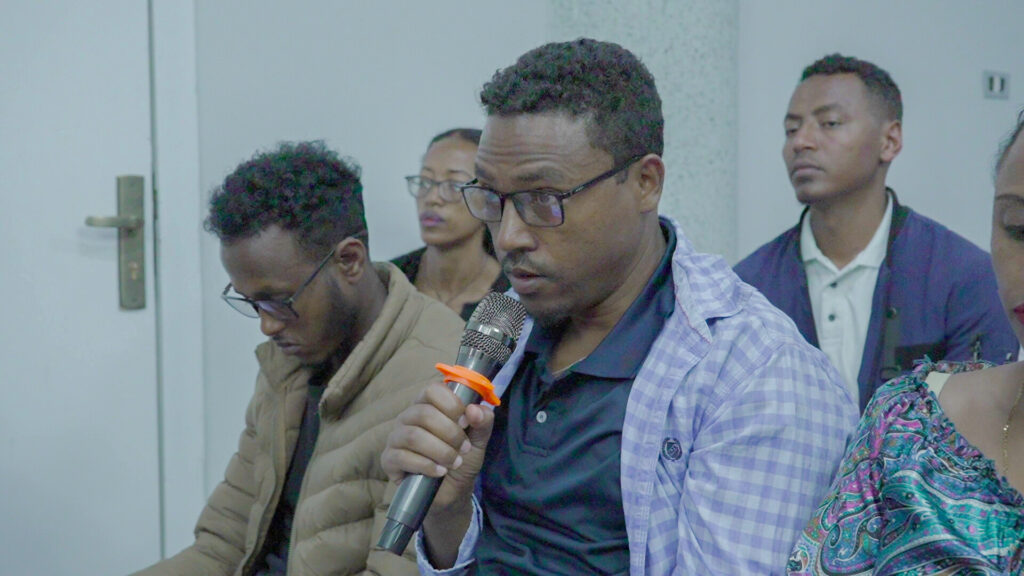
During the press conference, the Chief Commissioner provided comprehensive clarifications in response to inquiries from media professionals regarding current human rights issues. Addressing concerns related to arbitrary detention and enforced disappearances, the Chief Commissioner affirmed that EHRC continues to monitor and investigate such cases, noting that complaints to this effect have been received. He emphasized that EHRC operates free from undue influence, including from the government, and adheres strictly to the principles of independence and neutrality. Furthermore, he noted that while EHRC collaborates with the government, international partners, and other relevant stakeholders to advance human rights, its autonomy is clearly evidenced by the integrity of its operations and published reports. Finally, the Chief Commissioner detailed EHRC’s ongoing commitment to ensure that the implementation of transitional justice remains human-rights-centered and compliant with international standards.
In his concluding remarks, EHRC Chief Commissioner Berhanu Adelo emphasized that the full implementation of EHRC’s recommendations is essential to improve the human rights situation in Ethiopia. He urged governmental and non-governmental organizations, as well as all stakeholders in the human rights sector, to discharge their responsibilities accordingly. The Chief Commissioner further called upon all stakeholders to extend proactive cooperation and support to ensure the successful hosting of NANHRI’s 2027 General Assembly and 16th Biennial Conference in Addis Ababa, Ethiopia.